
How to Find Who Owns a Taylor County Property
The statewide Assessor search is the natural first stop when you hold an address or parcel number. Pick Taylor County. From there, query by owner, street, district, map, parcel, subparcel, property class, tax class, or land use. Keep the order exact: district, map, parcel, suffix. What you get is the current owner label on a tax parcel, which is practical but is not a deed or title certificate.
For the recorded transfer behind that label, move to the County Clerk's compiled index. Run the party name in grantor and grantee roles. Then open the instrument and compare its legal description. A mismatch usually means one of two things. Either the deed was recorded after the assessment update, or a name, mailing address, or parcel identifier has changed along the way.
- Find the parcel in the assessment search and note its complete ID and tax year.
- Compare the displayed owner name with the most recent recorded deed.
- Check that the deed’s legal description matches the assessed tract.
- Ask the Assessor or Clerk about an unresolved record difference.
An owner label is a starting point, not an identity match. Similar names may be unrelated. One owner may appear under different initials. Distinguish a true match with the parcel's physical location, assessment year, and full identifier. When the result is an LLC, trust, estate, or couple, copy the name exactly as shown. Do this before searching the deed index.
Where Taylor County Owner Information Appears
On the Assessor portal, you can search by owner name or by parcel. Basic, Appraisal-Sales, Advanced, and Prior Ownership modes are offered. No fixed list of fields appears for every record, though. A selected parcel typically shows an owner label, site address, and assessment details. Even so, search results do not prove that every co-owner or trust beneficiary appears.
The portal sits inside West Virginia's assessment system. Select Taylor County first. Verify the district before narrowing a name search. When a result looks close, do not trust a similar name. Confirm the parcel number and address instead. Then turn to the Clerk index for the deed and the recorded party roles.
| Assessor owner field | Current name associated with a parcel in the assessment roll |
|---|---|
| County Clerk index | Searchable recorded-party roles and deed references |
| Parcel viewer | Physical location and displayed parcel attributes |
| Source deed | Recorded parties, legal description, and transfer details |
Open the West Virginia assessment search to search Taylor County by owner or parcel.
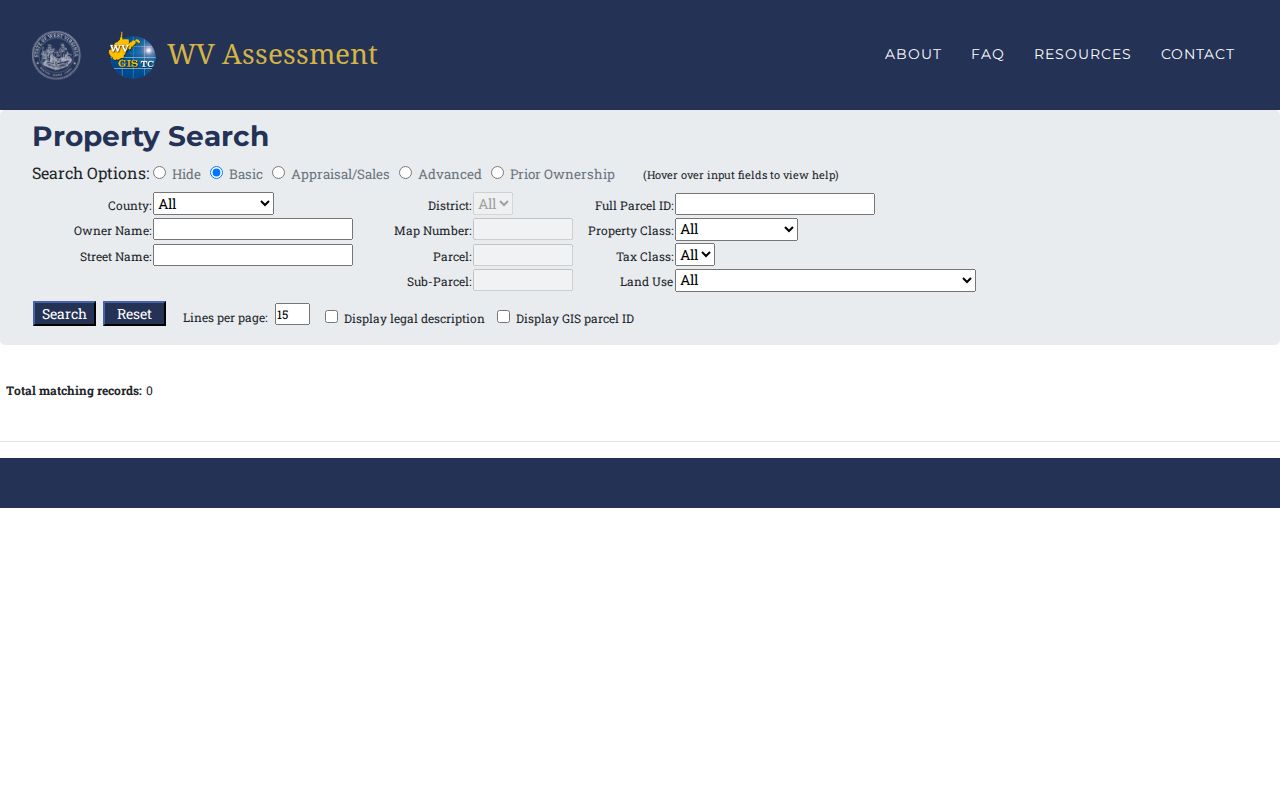
The Assessor page lists the Taylor County search modes. Confirm the owner and parcel in the individual result and the source deed.
Taylor County Owner Mail and Situs
The WV Property Viewer draws a line between a physical address and an owner mailing address. In Taylor County they can point to different places. Use the physical address to locate the parcel. Treat the mailing address only as the tax-roll destination. An owner's mail address is not necessarily another parcel, and a Grafton postal name does not prove a city boundary.
When the question is who owns the land now, compare the displayed owner with the current deed. Ask the Assessor about a recent roll change. The Taylor County current-owner record explains the owner field and the July 1 update context in more detail.
Older Taylor County Owner Clues
The online Clerk index has no published start year. The Archives finding aid gives Taylor County a fallback. Its catalog lists deed books from 1844 to 1901 and a deed index running from 1844 through 1970. Those dates can surface an earlier name when the modern record search comes up empty. They say nothing about the portal's coverage range.
For a property history question, work from the parcel's deed reference. Ask the Clerk or Archives for the right volume. City directories and newspapers at the local library can connect an old road description to a family or business name. The deed remains the land record.
Confirm the Owner Through a Recorded Transfer
A deed search ties the owner label to a recorded instrument. Run the displayed name as grantee to find an acquisition. Run it again as grantor to spot a later transfer. The instrument date, book and page, and party role anchor the record. The description tells you whether it matches the parcel. Deeds often describe land by district and adjoining-owner calls. An address-only comparison can fall short.
The Clerk index holds more than deeds. Liens, releases, wills, miscellaneous instruments, and UCC records sit alongside them. These can explain a party or a transaction history. They are not the deed that conveyed the property. See the Taylor County deed-record guide for party roles and retrieval limits.
Older deeds often cite a prior book and page in an “And Being” paragraph. Follow that reference instead of restarting from a street address. The citation can identify a volume that predates current street numbering. Compare the descriptions in both instruments. Note the date and role at each link.
Names, Trusts, and Co-Owners in Taylor County Records
Taylor County owners take many forms. An owner of record can show up in property records as an individual, a married couple, an estate representative, a trustee, or a business entity. The state parcel viewer may list a single owner even when the deed names co-owners. A matching trust label or company name is just a lead. It only becomes solid when the deed and the parcel description agree.
Search the exact form shown in the assessment result first. Then try a reasonable variation in the Clerk index. Initials, punctuation, or entity suffixes may differ. When a deed names a trustee, executor, or officer, weigh the stated role. Weigh the prior instrument too. Only then treat the signer as the beneficial owner. Taylor County property records are deep. But they are not a complete directory of private interests.
Resolve Differences Between Taylor County Sources
A mismatch between the assessment name and the recorded deed is not always an error. Check the document dates and the parcel description on each record first. The assessment roll moves on an annual cycle. The Taylor County Clerk records an instrument on the day it is filed. A transfer recorded after the valuation date explains many gaps. So does a parcel split, a suffix, or a simple spelling variation.
Ask the right office the right question. For a roll issue, the Assessor needs the full parcel number and tax year. For a deed issue, the Clerk needs both party names. It also needs an approximate recording date and any book/page reference. Each office keeps its own records and cannot certify the other's database.
Direction matters too. Starting from an address, find the parcel through the Assessor or the state viewer. Then carry that number into the deed index. Starting from a person, search the owner-name field, gather candidate parcels, and compare their physical addresses. Working both ways cuts the risk of grabbing a same-name entry. It also avoids a mailing address that points elsewhere.
Both offices sit in Grafton. The Assessor is at 214 W. Main Street, Room 107, Grafton, WV 26354, reachable at 304-265-2420, weekdays 8:30 a.m. to 4:30 p.m. The Clerk is at 128 W. Main Street, Annex 2, Grafton, WV 26354, at 304-265-1401, option 4. Tell the staff member which source disagrees. Hand over the parcel number and date so they can point to the correct record.
Certified deed copies belong with the Clerk. Corrections to an assessment name or parcel field belong with the Assessor. Keeping the requests separate resolves a mismatch faster than treating one screen as final.
For an older owner of record, the Archives finding aid reaches past the modern portal. Taylor County deed books are cataloged for 1844 through 1901, and the deed index runs through 1970. The online index publishes no start year. So treat those archive dates as the fallback. Ask the custodian which volume, image, or microfilm exists.
Limits of a Taylor County Owner Search
A public Taylor County property search has real limits. It can name the owner of record on the current assessment and locate recorded instruments, but it cannot settle legal ownership, title priority, or every unrecorded interest on its own. The tax roll updates on its own schedule. A GIS map popup may show just one owner label. The tax-mailing address can differ from the physical address of the parcel.
For a purchase, an estate, a dispute, or a court filing, pull the recorded deeds and have the chain reviewed by a title professional or attorney. An assessment correction belongs with the Assessor. A certified instrument comes from the County Clerk. Keep the source office and the date checked beside every result you save.
Availability has edges too. Some older Taylor County material appears only in an Archives finding aid, and the Clerk states no online start year for its deed index. When a property search comes up empty, try another record route or ask the custodian directly. Never assume an owner or a transfer never existed.